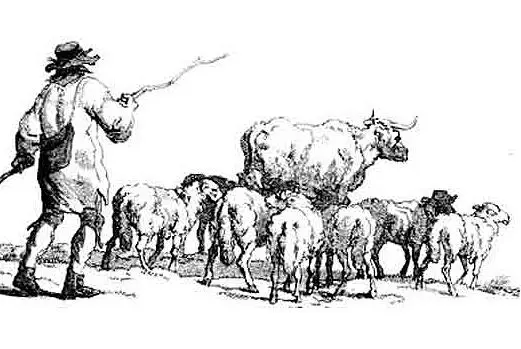
On 6th January, Tim Healey returned to Henley to give an entertaining and informative talk to members of the Henley Archaeological and Historical Group about the droving of cattle, sheep and other animals. Droving has been carried out from ancient times until the 19th century to bring animals from Wales to market in London, often through Oxfordshire, as this was a particularly convenient route.
The drovers’ journey could take as long as 3 weeks, during which they used long roads, such as the Ridgeway, and a network of local roads. Many of these roads survive, with names like Green Lane or the Welsh Way, and further evidence of the activity remains with pubs bearing names such as the Drovers Arms. Wide roads were particularly attractive for droving, and the Fair Mile in Henley (on the Lechlade – Abingdon – Nettlebed – London route) was used for this purpose.
Drovers had a hard life. They needed to continue their journey through all weathers and had to spend the night with their animals. They travelled in groups of around 30 men and several hundred animals, wore heavy clothing and were allowed to carry firearms.
To compensate for these hardships, droving was a lucrative business – typically, cattle would fetch twice as much in London (at Barnet Fair or Smithfield Market) as in Wales. This meant that, on their return journeys, drovers carried large sums of money and were attractive and vulnerable targets for robbers. They could reduce the risk of loss by carrying money in the form of promissory notes issued by country banks, which could be redeemed only on properly accredited premises. This was the start of the “Black Ox Bank”, eventually acquired by Lloyds.